Backdoor Roth IRA step by step, and how to avoid the pro-rata trap
Updated October 12, 2026 · Reading time: 5 min · 7 sections
With a MAGI of $190,000, a single filer cannot put a dollar into a Roth IRA directly, yet a backdoor Roth IRA can still end up in the same place: a nondeductible Traditional contribution followed by a conversion. It works cleanly for some people and costs real tax for others, and the difference is one rule.
I like the backdoor for its simplicity and I distrust it for the same reason. The two steps take minutes, so people skip the one check that matters, which is what else sits in their IRAs on December 31.
Who needs it
Anyone whose MAGI is above the top of the Roth range: $168,000 for a single filer or $252,000 for joint filers for 2026. The rules put no income limit on making a nondeductible Traditional contribution, and none on converting a Traditional IRA to a Roth. They only put a limit on contributing directly. Inside the range you can still contribute a reduced amount, as worked out in the contribution-limits guide.
You still need earned income, and the usual IRA limit applies to the Traditional contribution: $7,500 for 2026, or $8,600 at 50 and older, shared across all your IRAs.
The steps
- Check your other IRAs first. Add up every Traditional, SEP and SIMPLE IRA balance. If it is zero, the conversion is almost tax-free. If it is not, jump to the pro-rata section before going further.
- Contribute to a Traditional IRA and do not deduct it. A contribution is nondeductible when you choose not to claim it, or when the deduction has phased out because a workplace plan covers you.
- Keep the money in cash until it is converted. Any growth between the deposit and the conversion is pre-tax and becomes taxable income. Convert fast, within days.
- Convert it to your Roth IRA. The conversion itself is a taxable event: the taxable part is added to that year's income.
- File Form 8606. This form is what proves the contribution was after-tax. Without it the IRS has no record of your basis.
Form 8606 keeps the books
Part I tracks your basis, the nondeductible money you have put in over the years. Part II works out how much of a conversion is taxable. You file it for every year with a nondeductible contribution or a conversion. A missing Form 8606 is an easy mistake to make, and a tax professional can help you catch up on one. Publication 590-A explains the lines.
The pro-rata trap
You cannot pick which dollars you convert. The IRS treats all your Traditional, SEP and SIMPLE IRAs as a single pot, and every conversion is a slice of the whole mix of pre-tax and after-tax money, measured on December 31 of the conversion year plus the conversion itself.
Example, with invented but ordinary numbers. You contribute $7,500 nondeductible. You also hold $42,500 of old pre-tax IRA money from a rolled-over job plan. You convert the $7,500.
| Step | Amount |
|---|---|
| Nondeductible basis | $7,500 |
| Pre-tax IRA money left at year-end | $42,500 |
| Year-end balance plus the $7,500 converted | $50,000 |
| Tax-free share: $7,500 ÷ $50,000 | 15% |
| Tax-free part of the conversion: 15% × $7,500 | $1,125 |
| Taxable part of the conversion | $6,375 |
| Basis still unused, carried forward on Form 8606 | $6,375 |
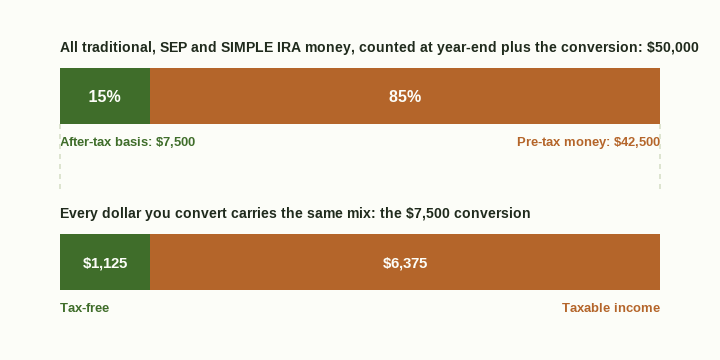
You wanted a tax-free conversion and got 85% taxable. Your unused basis is not lost, it comes out gradually over later conversions and withdrawals, but the result is rarely what the backdoor was meant to achieve. The same $7,500 with no other IRA money would have been 100% tax-free.
Ways around the trap
- Do not use the backdoor while you hold pre-tax IRA money. This is the simplest rule I know.
- Move the pre-tax money out of the pot. Employer plans such as a 401(k) are not counted in the pro-rata calculation, and some plans accept rollovers from an IRA. If yours does, doing that before December 31 can empty the pot. Check with the plan administrator first, because not all do.
- Accept the tax on purpose. A larger conversion can be a deliberate decision when you expect a lower bracket this year. That is a tax question, not a backdoor question.
Clocks and limits that still apply
- The conversion clock. Each conversion has its own 5-year period for the 10% additional tax on early withdrawals of the converted amount, when you are under 59½ (Publication 590-B).
- The qualified-distribution clock. Separate again: it starts on January 1 of the first tax year you contributed to any Roth IRA, and you need it plus age 59½, disability, death or a first home (up to $10,000) for tax-free earnings.
- Order of withdrawals. Regular contributions first, then conversions on a first-in, first-out basis, then earnings.
- No undo. A conversion cannot be recharacterized back to a Traditional IRA, so check the numbers before pressing the button.
Checklist before you convert
- MAGI is above the Roth range, or the reduced amount is not enough for you.
- Total Traditional, SEP and SIMPLE IRA balances are zero, or the pro-rata cost is accepted.
- The contribution is within your IRA limit and your earned income.
- The contribution is marked nondeductible and the money stays uninvested until converted.
- I know the tax I will owe on the taxable part, and I have cash outside the IRA to pay it.
- Form 8606 is on my list for the return.
For the comparison behind the choice, see the Roth vs Traditional guide, and use the Roth IRA calculator to project what a converted balance can grow to.
Estimates for education, not tax, legal or investment advice. Rules have exceptions; check IRS Publication 590-A and 590-B or a tax professional for your situation.
Quick answers
What is a backdoor Roth IRA?
It is a two-step route: make a nondeductible contribution to a Traditional IRA, then convert it to a Roth IRA. The rules set no income limit on either step, which is why people above the Roth range use it.
What is the pro-rata rule?
The IRS treats all your Traditional, SEP and SIMPLE IRAs as one pot. A conversion is taxed in proportion to the pre-tax share of the whole pot at year-end plus the conversion, so old pre-tax money makes most of it taxable.
Can I contribute to a Roth IRA if I am over the income limit?
Not directly. Above the top of the phase-out range the allowed Roth contribution is zero, and a backdoor conversion is the route people use; a tax professional can confirm how it applies to you.
Can I undo a Roth conversion?
No. A conversion can no longer be recharacterized, so the tax on its taxable part stands once you convert.