Roth IRA Calculator Built on What You May Actually Contribute
A Roth IRA calculator should start from what the IRS lets you put in: enter your age, filing status and MAGI, and the projection uses your allowed amount, compares Roth with Traditional after tax and shows the result in today's dollars.
Roth IRA Calculator
Allowed this tax year
Roth IRA balance at retirement
- Current balance
- —
- New contributions
- —
- Growth
- —
Roth vs Traditional, same out-of-pocket cost
after taxHow the comparison works
Both accounts get the same contribution. The Traditional IRA deducts it, so the tax you save now goes into a taxable side account; at retirement the Traditional balance is taxed at your retirement rate. The taxable account gets the same contribution with its growth taxed every year. Your current balance counts as Roth money in the Roth and Traditional columns.
Withdrawal map
—- Contributions (basis), withdrawable any time
- —
- Earnings
- —
Growth year by year
Tap or click the chart to move the withdrawal map to that age.
Year-by-year schedule
| Age | Allowed | Contribution | Roth start | Roth end | Taxable end |
|---|
Estimates for education, not tax, legal or investment advice. Rules have exceptions; check IRS Publication 590-A/590-B or a tax professional for your situation. Everything is calculated in your browser; nothing is sent anywhere.
A Roth IRA calculator is only worth trusting when it starts from a contribution you are actually allowed to make. The calculator above works the way I do it on paper: first the allowed amount for your tax year, age, filing status, MAGI and earned income; then the growth; then the same money in a Traditional IRA after tax; then which part you could take out, and from what age.
What each input means
- Current balance is what the account holds today. The optional past contributions field says how much of it is money you put in rather than growth; it feeds the withdrawal map, and left blank the whole balance counts as earnings. For the contribution, type a yearly amount, or tick the maximum box and the calculator puts in whatever you are allowed each year.
- Tax year selects the IRS table of limits and phase-out ranges. The newest year is the default; the previous one is there for last-year contributions.
- Filing status and MAGI. There are five choices; married filing separately has a second one for couples who lived apart all year, and it uses the single range. MAGI is modified adjusted gross income as Pub 590-A defines it for Roth purposes, not your salary. Check your MAGI before you fund the account, not after.
- Earned income means taxable compensation: wages, salary, net self-employment income. Leave it blank when it is well above the limit.
- Expected return and inflation are yours to set. I run two or three return rates and read the range.
- Tax rate now and tax rate in retirement drive the Roth vs Traditional comparison. Use marginal rates, not your average rate.
- Tax on growth in a taxable account is the yearly drag on an ordinary brokerage account. The default 15% is an assumption; taxing every dollar of growth at your full ordinary rate, as many calculators do, overstates the Roth advantage.
Every field is checked on screen, and nothing is calculated until all of them are valid, so you never see a result built on a number the tool quietly changed. Age must be a whole number from 18 to 99; the retirement age must be above your age and no more than 100; the return runs from −5% to 15%, tax rates from 0% to 60%, inflation from 0% to 10%; past contributions cannot be more than the balance.
How much you can put in a Roth IRA
| Tax year | Under 50 | Age 50+ | Single or head of household | Married filing jointly | Married filing separately |
|---|---|---|---|---|---|
| 2026 | $7,500 | $8,600 | $153,000–$168,000 | $242,000–$252,000 | $0–$10,000 |
| 2025 | $7,000 | $8,000 | $150,000–$165,000 | $236,000–$246,000 | $0–$10,000 |
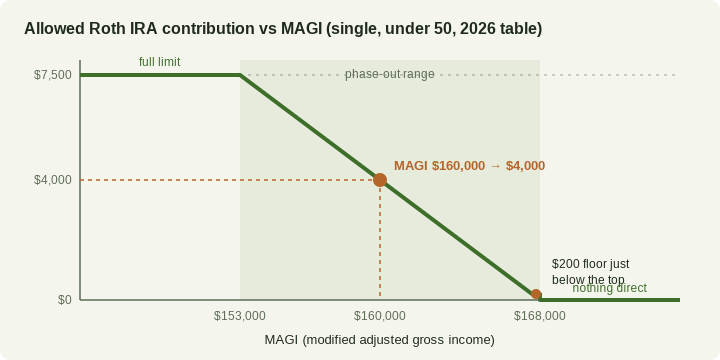
Sources: IRA contribution limits and the IRS release with the 2026 ranges. The catch-up is $1,100 for 2026 ($1,000 before) and applies if you are 50 or older by the end of the tax year. Below the range you may put in the full limit; at or above the top, nothing directly. Inside it, Worksheet 2-2 of Publication 590-A gives the reduced amount:
Single, MAGI $160,000, age 35, 2026 table: ($160,000 − $153,000) ÷ $15,000 = 0.4667; 0.4667 × $7,500 = $3,500; $7,500 − $3,500 = $4,000. The same saver at 55 starts from $8,600: 0.4667 × $8,600 = $4,013.33; $8,600 − $4,013.33 = $4,586.67, rounded up to $4,590. The calculator prints this line in words for your own numbers, next to a gauge that shows where your MAGI sits inside the range.
- Range width is $15,000 for single and head of household, $10,000 for married filing jointly and separately. Married filing jointly at $245,000: $3,000 ÷ $10,000 = 0.3; 0.3 × $7,500 = $2,250; allowed $5,250.
- The $200 floor. Single at $167,900 the worksheet leaves $50, yet you may still put in $200. At $168,000 the answer is $0.
- Earned-income cap. You can never contribute more than your taxable compensation. A student with $3,000 of wages can put in $3,000, whatever the limit says.
- Spousal IRA. Filing jointly, each spouse may have a Roth IRA even if one has no pay, as long as the combined contributions do not exceed the joint compensation.
- Married filing separately but did not live with your spouse at any time in the year: use the single range (the "lived apart all year" choice does this).
- Deadline: the tax-filing deadline (mid-April of the next year, extensions don't count).
- Too much in: an excess contribution owes a 6% excise tax for every year it stays in the account. If you type more than you are allowed, the projection is capped at the allowed amount and the calculator says so.
If your allowed amount is zero, the calculator shows $0, projects no new contributions and links to the backdoor guide. The usual route is a backdoor Roth; read how a backdoor Roth works and how to avoid the pro-rata trap before you try it. The full worksheet with more cases is in Roth IRA contribution limits and the reduced-amount math.
Three projections from the Roth IRA calculator
Contributions go in at the start of each year and grow at a fixed return you choose. All three examples use the 2026 limits throughout.
| Saver | Inputs | Balance | Money you put in |
|---|---|---|---|
| Age 30 at the limit | $7,500 a year, 30 → 65, 7% | $1,109,351 | $262,500 |
| Maxing out with catch-up | $7,500, then $8,600 from age 50; 30 → 65, 7% | $1,138,928 | $279,000 |
| Late starter | $25,000 already saved; maxing out 45 → 67, 6% | $467,953 | $25,000 + $183,700 |
The first line is what most people search for: about $1.11 million at 65. Now the honest number. At 2.5% inflation, prices over 35 years rise by a factor of 1.025 to the 35th power = 2.3732, so $1,109,351 ÷ 2.3732 = $467,448 in today's dollars. The "Show in today's dollars" switch in the calculator applies the same division to the headline balance, the chart and the year-by-year schedule. The same $7,500 a year in a taxable account, with 15% tax on each year's growth, ends near $876,118, so the Roth's tax-free growth is worth about $233,000 in this setup.
The catch-up adds 15 × $1,100 = $16,500 of contributions and $29,577 of balance. For the late starter, five years at $7,500 and seventeen at $8,600 make $183,700.
Roth or Traditional: compare after-tax dollars
Compare after-tax dollars, not balances. Both accounts get the same $7,500 a year. The Traditional contribution saves tax now (contribution × tax rate now); that saving goes into a side account. At retirement the Traditional balance is taxed at your retirement rate and the side account is added back.
| Rate now | Rate in retirement | Tax on side-account growth | Roth after tax | Traditional after tax |
|---|---|---|---|---|
| 22% | 22% | 0% | $1,109,351 | $1,109,351 |
| 24% | 12% | 0% | $1,109,351 | $1,242,473 |
| 12% | 22% | 0% | $1,109,351 | $998,416 |
| 22% | 22% | 15% | $1,109,351 | $1,058,040 |
With equal rates and no drag the two are identical. The deciding number is the break-even retirement rate: side account ÷ Traditional balance. With no drag it equals your rate now; with a 15% drag on the side account it drops to 17.37%, so at a 22% rate today the Traditional wins only if your retirement rate falls below about 17.4%. A Traditional contribution may not be deductible at all if you are covered by a workplace plan (2026 ranges: single $81,000–$91,000, joint $129,000–$149,000, $242,000–$252,000 if only your spouse is covered); a nondeductible Traditional contribution changes the comparison completely. More in Roth vs Traditional IRA: the tax-rate test.
Getting money out of a Roth IRA
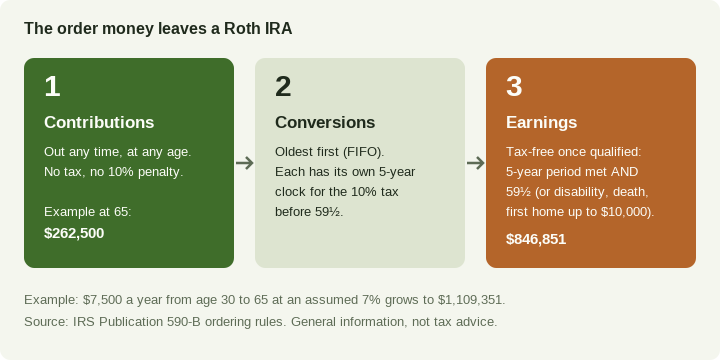
- Contributions come out first, so they are never locked away. In the age-30 example, $262,500 of the $1,109,351 is basis you could take back at any age; the other $846,851 is earnings.
- Earnings are tax- and penalty-free only in a qualified distribution: the 5-year period, which starts on January 1 of the first tax year you contributed to any Roth IRA, plus age 59½, disability, death or a first home (up to $10,000).
- The withdrawal map splits the account into contributions and earnings at any age you choose, with the slider or by clicking the chart, and draws a timeline with the earliest qualified age: the later of 59½ and your age at the first Roth contribution plus 5. Open a first Roth at 57 and that is 62. If you already have a Roth IRA, tick the box and enter how many years ago you opened it. A prior-year contribution made before the deadline starts the clock on January 1 of that earlier tax year.
- Conversions come out after contributions, oldest first, and each one has its own 5-year clock for the 10% additional tax.
- The original owner never has to take required minimum distributions. Details: Publication 590-B.
The arithmetic behind every figure
Each formula is short enough to repeat with a pocket calculator:
- Allowed contribution for a year: limit = base + catch-up if your age that year is 50 or more; capped by earned income; reduced by Worksheet 2-2; then the smaller of your chosen amount and the allowed amount.
- Roth balance, contributions at the start of the year: balance = (balance + contribution) × (1 + return).
- Taxable account: balance = (balance + contribution) × (1 + return × (1 − tax on growth)).
- Traditional after tax = Traditional balance × (1 − retirement rate) + side account, which receives contribution × rate now each year and grows at return × (1 − tax on growth). Break-even rate = side account ÷ Traditional balance.
- Today's dollars = amount ÷ (1 + inflation) raised to the number of years.
Assumptions: the same IRS table every year (no guessing at future increases), one fixed return, no fees, money shown to the nearest dollar, allowed amounts rounded up to $10 as the IRS does. Everything runs in your browser; nothing you type is sent anywhere. The share link keeps your inputs after the # sign of the address, a part a server never receives; there are also buttons to copy a summary, download the schedule as a CSV file and print. The tree-ring picture beside the balance draws your contributions as the core and one ring of growth per year around it. The tool's test page recomputes these control cases and must match them to the dollar:
| Case | Inputs | Expected |
|---|---|---|
| Growth | $7,500 a year, 30 → 65, 7% | $1,109,351; contributions $262,500 |
| Catch-up | Maximize, 30 → 65, 7% | $1,138,928; contributions $279,000 |
| Late starter | $25,000 now, maximize, 45 → 67, 6% | $467,953; new contributions $183,700 |
| Reduced amount | Single MAGI $160,000 at 35 / at 55; joint $245,000; earned income $3,000 | $4,000 / $4,590 / $5,250 / $3,000 |
| Edges of the range | Single MAGI $167,500 / $167,900 / $168,000; married filing separately $4,000; 2025 single $157,500 | $250 / $200 / $0; $4,500; $3,500 |
| Roth vs Traditional | 24% now, 12% later, no drag | Traditional $1,242,473 vs Roth $1,109,351 |
| Default rates | 22% now and later, 15% drag on the side account | Traditional $1,058,040; break-even 17.37% |
| Taxable account | $7,500 a year, 30 → 65, 7%, 15% drag | $876,118 |
| Today's dollars | Growth case at 2.5% inflation | $467,448 |
Guides
 Roth vs Traditional IRA: the tax-rate test that decides itEqual rates give a tie. See which tax-rate changes, side-account taxes and limits tip the choice between a Roth and a Traditional IRA.Reading time: 6 min
 Roth IRA contribution limits: catch-up, phase-out, reduced amountThree caps decide what you may put in: the IRS limit, your earned income and your MAGI. Worked examples of the reduced-amount worksheet.Reading time: 5 min
 Backdoor Roth IRA step by step, and how to avoid the pro-rata trapA nondeductible contribution plus a conversion opens the Roth when income is too high. See the Form 8606 math and the pro-rata trap.Reading time: 5 min
Quick answers
How much will my Roth IRA be worth when I retire?
It depends on what you put in, for how long and the return you assume. $7,500 at the start of each year from 30 to 65 at an assumed 7% grows to about $1.11 million, or about $467,000 in today's dollars at 2.5% inflation.
How much can I contribute to a Roth IRA for 2026?
$7,500, or $8,600 if you are 50 or older by the end of the year, but never more than your taxable compensation. Inside the MAGI phase-out ($153,000–$168,000 single, $242,000–$252,000 joint) the amount is reduced by the Pub 590-A worksheet.
Can I contribute to a Roth IRA if I'm over the income limit?
Not directly. Many people use a backdoor Roth: a nondeductible Traditional IRA contribution followed by a conversion. If you hold other pre-tax IRA money, the pro-rata rule makes most of that conversion taxable.
What happens if I contribute too much to a Roth IRA?
The excess owes a 6% excise tax for every year it stays in the account. Taking the excess and its earnings out in time generally avoids that tax; Publication 590-A explains the deadline and how the earnings are taxed.
Can I still contribute to a Roth IRA for last year?
Yes, until the tax-filing deadline (mid-April of the next year, extensions don't count). Tell your IRA provider which tax year the deposit is for.
When can I withdraw from a Roth IRA without penalty?
Your contributions can come out any time without tax or penalty. Earnings are tax- and penalty-free once the 5-year period has passed and you are 59½, disabled, or using up to $10,000 for a first home.
Updated · About this site