Roth IRA contribution limits: catch-up, phase-out, reduced amount
Updated October 12, 2026 · Reading time: 5 min · 6 sections
Roth IRA contribution limits come in three layers, and the layer people forget is the one that costs them money: the IRS dollar limit, your earned income, and your MAGI. Your allowed amount is the smallest result of the three.
I tell savers to check the income layer before they fund the account, not at tax time, because the penalty for getting it wrong keeps running until you fix it. Work through the layers in this order and you will land on a number you can defend.
The dollar limits by tax year
The IRS sets one limit that covers all your IRAs together, Roth and Traditional. Put $4,000 in a Traditional IRA and you have room for $3,500 more in a Roth, not another $7,500. If you are 50 or older by the end of the year, you add the catch-up. The calendar year you turn 50 counts, even if the birthday is in December.
| Tax year | Limit | Age 50+ | Single or head of household | Married filing jointly |
|---|---|---|---|---|
| 2026 | $7,500 | $8,600 (catch-up $1,100) | $153,000 to $168,000 | $242,000 to $252,000 |
| 2025 | $7,000 | $8,000 (catch-up $1,000) | $150,000 to $165,000 | $236,000 to $246,000 |
Married filing separately has its own range of $0 to $10,000 for both years. The figures come from the IRS pages on IRA contribution limits and the annual limit announcement.
Layer two: your earned income
You can never contribute more than your taxable compensation for the year. A student who earned $3,000 from a summer job can put in $3,000, even if MAGI is zero. Investment income, rent and most benefits do not count as compensation.
Married couples filing jointly get the spousal rule. Each spouse has a separate IRA and a separate limit, but the two contributions together cannot exceed the joint compensation. If one spouse earned $9,000 and the other nothing, the couple can contribute at most $9,000 in total, for example $7,500 to one account and $1,500 to the other.
Layer three: MAGI and the phase-out
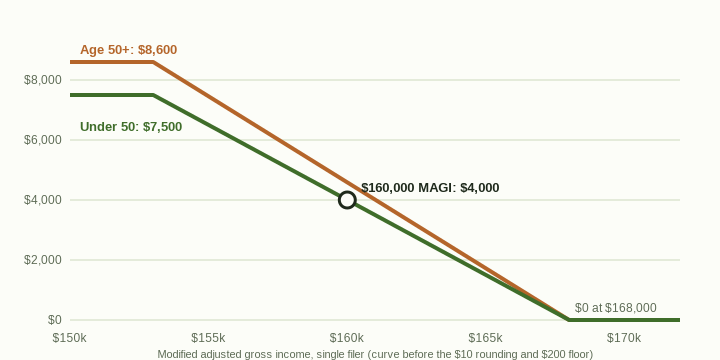
MAGI is your adjusted gross income with a few items added back; Publication 590-A has the worksheet, so start from the AGI line on your return and follow it. At or below the bottom of your range you may contribute the full limit. At or above the top you may contribute nothing directly. In between, the amount shrinks along a straight line.
The reduced-amount worksheet, step by step
Publication 590-A (Worksheet 2-2) gives the rule. In plain words:
- Subtract the bottom of your range from your MAGI.
- Divide by the width of the range: $15,000 for single and head of household, $10,000 for joint and separate.
- Multiply that fraction by your limit, then subtract the result from the limit.
- Round up to the next multiple of $10. If the result is above zero but under $200, you may still contribute $200.
| Case | Arithmetic | Allowed |
|---|---|---|
| Single, MAGI $160,000, age 35 | ($160,000 − $153,000) ÷ $15,000 = 0.4667; × $7,500 = $3,500; $7,500 − $3,500 | $4,000 |
| Same, age 55 | 0.4667 × $8,600 = $4,013.33; $8,600 − $4,013.33 = $4,586.67, rounded up | $4,590 |
| Married filing jointly, MAGI $245,000 | ($245,000 − $242,000) ÷ $10,000 = 0.3; × $7,500 = $2,250; $7,500 − $2,250 | $5,250 |
| Single, MAGI $167,900 | 14,900 ÷ 15,000 = 0.9933; × $7,500 = $7,450; $7,500 − $7,450 = $50, raised to the minimum | $200 |
| Married filing separately, MAGI $4,000 | $4,000 ÷ $10,000 = 0.4; × $7,500 = $3,000; $7,500 − $3,000 | $4,500 |
Two traps hide in that table. The rounding goes up, so you land on the next $10 above the raw result. And the $200 floor means a MAGI one step below the top can still allow a small contribution, while $168,000 itself allows none. If your earned income is lower than the worksheet result, the lower number wins.
Married filing separately
Filing separately and living with your spouse at any time during the year puts you in the $0 to $10,000 range, which is why almost nobody in that situation can contribute much. If you filed separately and did not live with your spouse at any point in the year, you use the single range instead.
The deadline, and which year you pick
You can fund a tax year until the return due date for that year, which is mid-April of the following year. Extensions do not move it. Between January and that date, tell your custodian which tax year the deposit is for, otherwise it may land in the current one by default.
What happens if you put in too much
An excess contribution is taxed at 6% for every year it stays in the account. A $3,500 excess costs $210 a year, every year, until it is removed or absorbed. Publication 590-A describes the ways to correct it, including taking the excess out with the earnings it produced by the deadline, and I would ask a tax professional before moving anything, because the earnings are taxable and the timing matters.
If the worksheet gives you zero, the front door is closed but not the building. Read the backdoor Roth guide for what people do next, and the Roth vs Traditional guide if the deduction on a Traditional IRA is the alternative you are weighing. To see the allowed amount for your own numbers, enter them in the Roth IRA calculator: pick the tax year (2026 or 2025) and one of five filing statuses, including married filing separately with the "lived apart all year" choice that uses the single range, and it prints the worksheet line in words. A contribution above the allowed amount is capped in the projection, with a note about the 6% excise tax.
Estimates for education, not tax, legal or investment advice. Rules have exceptions; check IRS Publication 590-A and 590-B or a tax professional for your situation.
Quick answers
How much can I contribute to a Roth IRA this year?
For 2026 the limit is $7,500, or $8,600 if you are 50 or older, but never more than your taxable compensation, and it shrinks if your MAGI is inside the phase-out range.
How is the reduced Roth IRA amount calculated?
Subtract the bottom of your range from MAGI, divide by the range width, multiply by your limit and subtract that from the limit. Round up to the next $10; a result between $1 and $199 becomes $200.
Can I contribute to a Roth IRA for last year?
Yes, until the return due date for that year, mid-April of the next year. Extensions do not count, and you should tell the custodian which tax year the deposit belongs to.
What if I contribute too much to a Roth IRA?
The excess is hit with a 6% excise tax for every year it remains. Publication 590-A explains how to remove it with its earnings, and a tax professional can help with the timing.