Roth vs Traditional IRA: the tax-rate test that decides it
Updated October 12, 2026 · Reading time: 6 min · 6 sections
Put $7,500 a year into a Roth IRA and the same $7,500 into a Traditional IRA, keep your tax rate at 22% on the way in and on the way out, and after 35 years at 7% both savers can spend exactly $1,109,351. The tax-rate test below explains why, and what breaks the tie.
Most Roth vs Traditional IRA arguments compare the two account balances. I never do. A Traditional balance is owed a tax bill, a Roth balance is not, so a bigger number on the statement can still be the smaller pile of spendable money. The only fair scoreboard is money you can spend after tax.
Compare after-tax dollars on equal cost
Here is the setup I use, and the one the Roth IRA calculator runs. Each year you decide to save $7,500.
- Roth: $7,500 goes in from money you have already paid tax on. Nothing is owed at withdrawal.
- Traditional: $7,500 goes in and you deduct it. At a 22% rate the refund is $7,500 × 0.22 = $1,650, and you put that refund in a side account so your total outlay is the same $7,500.
At retirement the Traditional saver owes tax on every IRA withdrawal, so the spendable total is the IRA times (1 − retirement rate) plus the side account. The Roth saver simply has the Roth.
Break-even retirement rate = side account ÷ IRA
Why equal tax rates give a tie
With no tax on the side account, the side account ends up as 22% of the IRA balance, because it receives 22% of every contribution and grows at the same 7%. So the Traditional saver finishes with IRA × (1 − 0.22) + IRA × 0.22, which is the IRA balance itself. That is the Roth balance, to the dollar: $1,109,351.
That is the part beginners miss. Neither account magically grows faster. The Roth does not beat the Traditional by being "tax free", and the Traditional does not beat the Roth by "saving tax now". What matters is whether your rate in retirement is higher or lower than your rate today.
What happens when the rates differ
Same $7,500 a year, 35 years, 7% growth, contributions at the start of each year, side account untaxed. Amounts are in future dollars.
| Rate now | Rate in retirement | Roth | Traditional after tax | Winner |
|---|---|---|---|---|
| 22% | 22% | $1,109,351 | $1,109,351 | Tie |
| 24% | 12% | $1,109,351 | $1,242,473 | Traditional |
| 32% | 22% | $1,109,351 | $1,220,286 | Traditional |
| 12% | 22% | $1,109,351 | $998,416 | Roth |
| 22% | 32% | $1,109,351 | $998,416 | Roth |
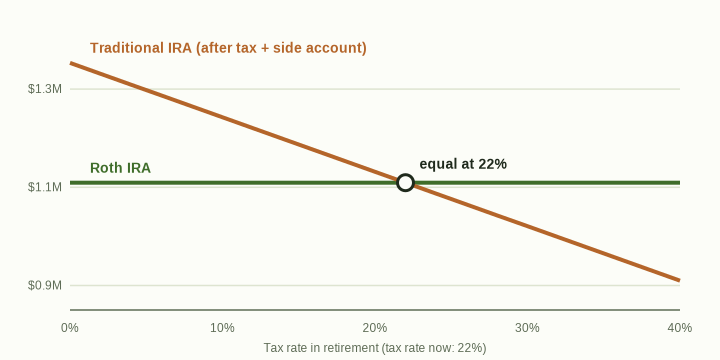
My rule of thumb: the Traditional IRA wins when you expect to be in a lower bracket in retirement, the Roth wins when you expect a higher one, and a tie is the honest answer when you cannot tell. The hard part is the guess. Do not use your current pay for the retirement rate. Estimate the taxable income you would draw, after the standard deduction, then read the bracket from the IRS tables.
What tilts the result
The table assumes a perfect side account. Real life adds five things.
- The refund gets taxed or spent. If the side account is taxable, it grows more slowly, and the Traditional result shrinks. This is the single biggest tilt toward Roth (details in the next table).
- Room under the limit. The limit counts dollars, not tax value. A Roth dollar is an after-tax dollar, so $7,500 in a Roth does the work of about $9,615 in a Traditional at a 22% rate ($7,500 ÷ 0.78). If you can fill the limit, the Roth shelters more.
- No required minimum distributions. The original owner of a Roth IRA never has to take them (Publication 590-B). A Traditional IRA forces withdrawals even when you do not need the money.
- Access to contributions. Withdrawals come from regular contributions first, so those dollars can come out at any time without tax or penalty. A Traditional IRA has no such shelf.
- Whether the deduction exists at all. If you or your spouse is covered by a workplace plan, the Traditional deduction phases out. For 2026 that is $81,000 to $91,000 of MAGI for a single filer and $129,000 to $149,000 for joint filers (IRS announcement). Without a deduction a Traditional contribution has no tax benefit today, which is the fact the backdoor Roth is built on.
The taxed side account
Suppose the refund goes to a regular account where growth is taxed at 15% a year, so the side account earns 7% × (1 − 0.15) = 5.95%. Everything else is unchanged.
| Rate now | Rate in retirement | Roth | Traditional after tax | Break-even retirement rate |
|---|---|---|---|---|
| 22% | 22% | $1,109,351 | $1,058,040 | 17.37% |
| 24% | 12% | $1,109,351 | $1,186,497 | 18.95% |
| 12% | 22% | $1,109,351 | $970,428 | 9.48% |
Now equal rates favour the Roth by about $51,000, and the break-even retirement rate for a 22% saver drops from 22% to 17.37%. The Traditional IRA needs a retirement rate under that line to come out ahead. Read the first row again: nothing about the accounts changed, only what you do with the refund.
When splitting makes sense
Nobody knows their retirement bracket, and tax law moves. Saving some in each account is a way to avoid betting everything on one guess, and it gives you a taxable and a tax-free bucket to draw from later. A few cases I would think about, as general information rather than advice:
- Early career, low bracket, income likely to rise: the Roth side looks stronger.
- Peak earning years and a clear plan to live on much less: the Traditional side looks stronger, if you will really invest the refund.
- Income near the Roth limit: read the contribution-limit guide first, because your allowed Roth amount may already be reduced.
Change "Tax rate now", "Tax rate in retirement" and "Tax on growth in a taxable account" in the Roth IRA calculator and watch the three after-tax bars and the break-even rate move; it takes a minute and replaces an hour of opinions.
Estimates for education, not tax, legal or investment advice. Rules have exceptions; check IRS Publication 590-A and 590-B or a tax professional for your situation.
Quick answers
Is a Roth IRA or a Traditional IRA better?
Neither wins by default. On equal out-of-pocket cost they tie when your tax rate now equals your rate in retirement; the Traditional IRA is ahead if the retirement rate is lower, and the Roth is ahead if it is higher.
What is the break-even tax rate?
It is the retirement tax rate at which the Roth and Traditional results are equal. It equals the side account divided by the IRA balance, so with a tax-free side account it equals your rate today.
Why does the Roth win at equal tax rates in some comparisons?
When the refund from the Traditional deduction goes into a taxable account, tax drag slows it down. That makes the Traditional result smaller and moves the break-even rate below your current rate.
Can I contribute to both a Roth and a Traditional IRA in the same year?
Yes, but one limit covers all your IRAs together: $7,500 for 2026, or $8,600 if you are 50 or older. Splitting it between the two does not raise the total.